How is AI transforming traditional storytelling? What are the potential dangers of overusing artificial intelligence from a storytelling perspective? What role does reading play in developing storytelling skills? These were among the questions we discussed with Viktória Szabó, a lecturer at MOME, who led the highly successful AI and Storytelling workshop at the Worldcom Young Professionals Meeting 2026. The event was organized in collaboration with the Institute of Marketing and Communication Sciences at Corvinus University of Budapest.
Could you briefly summarize the essence of the mini-workshop held at WYPM 2026?
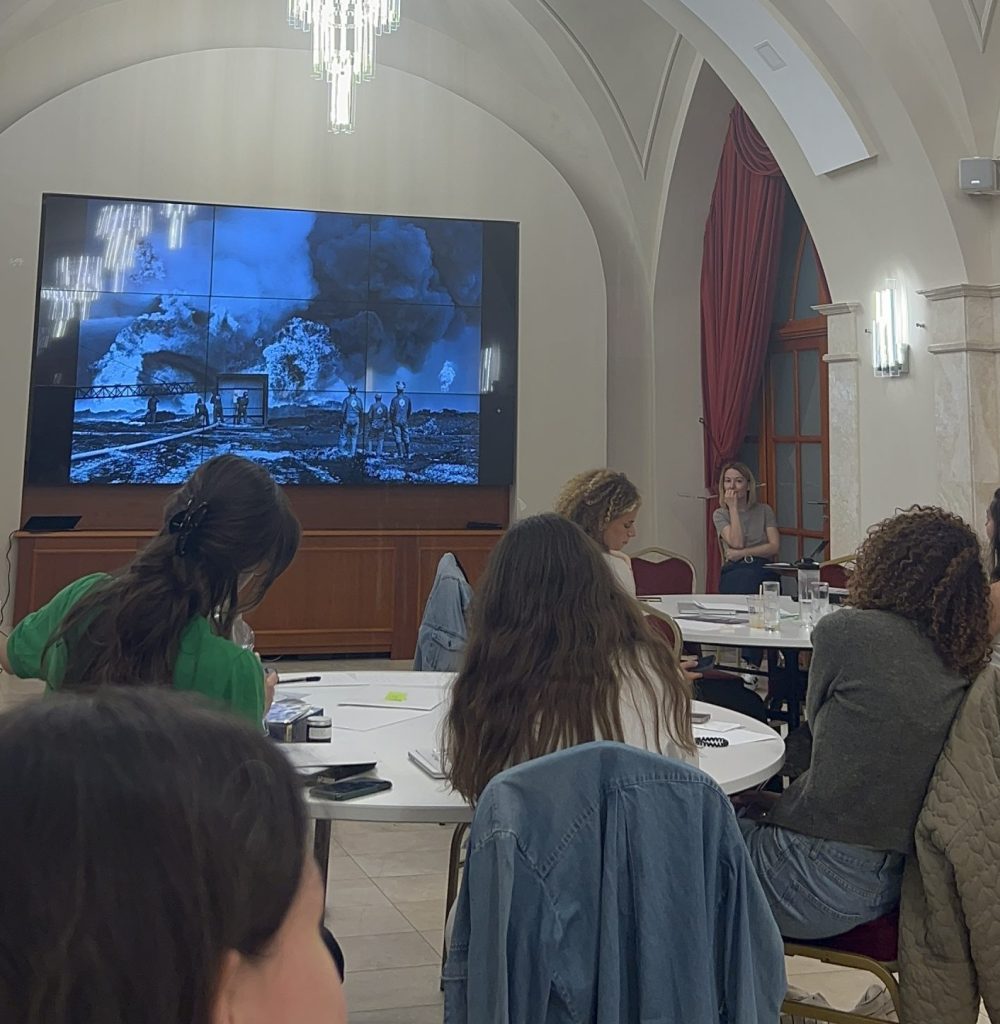
The “Storytelling & AI” workshop focused on developing storytelling techniques and exploring how these techniques help improve human-AI language interactions. Despite the topic, we didn’t use any digital tools, because I like to first understand something through analog means (here: paper and pencil) and then apply it in the digital world. We worked with simple storytelling tools, image description exercises, and practices aimed at developing descriptive language use.
You have close ties to both MOME and Corvinus – one an arts institution, the other focused on economics and social sciences. What are your thoughts on the significance, role, and potential of storytelling in artistic and economic contexts?
Before I arrived at Corvinus, I thought I had a perfectly clear understanding of what storytelling meant. It took two years to realize what storytelling actually means in that context. At MOME, it often means literally telling a story to an audience – as in an animated film, for example. We also use storytelling when we create the context for designing a product.
In an economic context, the emphasis is more on understanding processes: how stories influence our decisions and behavior – which, incidentally, is also the subtitle of an economics book I read a few years ago that had a great impact on me, even though I’m not an economist.
Why do you consider storytelling elements important in corporate communication, and why in interpersonal communication?
I don’t think there’s much difference between the two in terms of purpose. For me, storytelling is about building community. Storytelling is the tool through which I make the world (whether inner, outer, real, or imagined) understandable and expressible to others. The technique is essentially the same in both cases: creating a logical system, building cause-and-effect relationships, giving events a sense of time. This is just as important in corporate communication as it is in our everyday lives.
How do you think AI is transforming storytelling in general?
There are many ways to answer this question, ranging from synthetic media through AI aesthetics all the way to hyper-personalized content production. What interests me more right now is how storytelling tools affect human-AI interactions. In the workshop, we practiced creating increasingly precise descriptions and more detailed narratives. This helps us understand what level of detail is needed to get the most accurate outcome from a generative system. During the image description exercises, participants observed and understood a great deal about a given image. They realized you can’t get away with simply saying that an image shows X figures doing Y things.
From a storytelling perspective, what are the potential pitfalls of overusing AI? How should we use AI in corporate or interpersonal communication to avoid these pitfalls?
AI use in general comes with many pitfalls. The greatest danger, in my view, is cognitive offloading — that is, forgetting how to think and solve tasks independently. At both universities where I teach, I see the harmful side of this, but I also see what good practices look like. My experience is that when students enjoy a task, thinking becomes an experience in itself, and AI use becomes just a supplementary activity that speeds up the work and helps with getting through the more monotonous parts. I try to bring genuinely interesting problems into the classroom – ones that are actually rewarding to work on.
They say that if you don’t read or engage with great stories, you can’t be a great storyteller. What’s your view on the role of reading?
You’re asking this of a former Hungarian literature major 🙂 Reading isn’t just about consuming stories. Along the way, we learn a great many things: how to interpret text, see connections, imagine worlds, and reconstruct narratives when, for instance, we retell to someone what we’ve read. In short, it’s very important to me. At the same time, today we no longer make meaning exclusively through text. The visual world surrounding us is teaching the brain new skills. Younger generations can process an image in a much shorter time. That too is a form of reading. I think the skills we need keep shifting – what’s in the foreground changes constantly. Just think of the era before the printing press.
If someone truly wants to become a great corporate – or even personal – storyteller, what skills do they need to develop, and how can they practice?
I think the most important thing is to observe how others do it. Read, watch great films, stay curious. But even more important than that: pay attention. Understand the events and relationships unfolding around you, and be crystal clear about who you want to tell your story to.
After that, the how tends to take care of itself.

Viktória Szabó
Communication designer and educator with over 10 years of experience in creative leadership, project management and media innovation. Skilled in leading design teams, building client relationships, and translating complex ideas into engaging storytelling and visual communication strategies. Passionate about bridging technology, design, and education.